

September 17, 2026
- Two HCAM Webinars: New Guardianship Law and Navigating DCW Changes
- Join Us to Golf for a Great Cause
- MDHHS to Issue FY27 DCW Payment Guidance
- CMS Posts Quarterly SNF Consolidated Billing HCPCS Code Updates
- MedPAC Data Shows Lower SNF Use Among MA Beneficiaries
- Upcoming Downtown for File Transfer Service Portal and CHAMPS
- Join HCAM’s Legal/Regulatory Committee
- Please Provide Joint Provider Surveyor Training Feedback
- CMS Posts Updated SNF QRP Measure Calculations and Reporting User’s Manual
- CDC Updates Respiratory Virus Guidance for Health Care Personnel
- Happy National Assisted Living Week

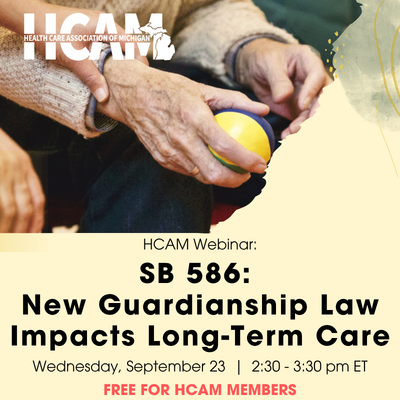 Learn what recently passed Senate Bill 586 means for nursing facility and assisted living residents, particularly when a guardian seeks to move a ward from their permanent residence. Andy Rothman and Rich Farran will explain the changes to Michigan law, what guardians are now required to do, and how the new requirements could affect admission and discharge processes. Attendees will also receive updates on the law’s implementation and what providers need to know.
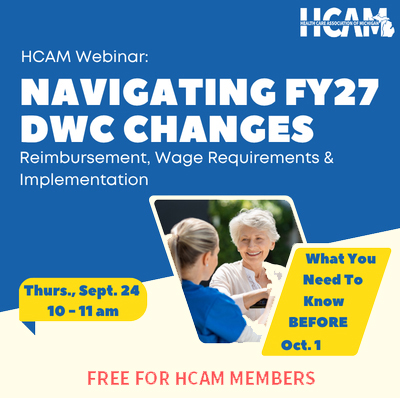 Beginning October 1, 2026, reimbursement for Michigan’s Direct Care Worker (DCW) and Non-Clinical Staff wage program will change significantly, with payments tied to each facility’s Medicaid utilization.
Join HCAM and Jon Lanczak of Plante Moran for a review of the FY27 DCW program changes, the latest MDHHS guidance, and what these updates mean for your facility. Presenters will walk through the reimbursement methodology, employee wage requirements, reporting expectations, implementation considerations, and key questions providers should address now.
 There’s Still Time to Hit the Links!
Grab your clubs and join us for the 2026 Lebenbom Classic Golf Tournament on September 28 at the Country Club of Lansing! Whether you’re a seasoned golfer or just along for the fun, it’s a great opportunity to get outside, enjoy a day on the course and connect with colleagues. And there’s a bigger reason to tee up: Proceeds support the David Lebenbom Memorial Scholarship, helping to support the sector. Don’t miss your chance to join us — we’ hope to see you on the course! Sign Up Today

MDHHS to Issue FY27 DCW Payment Guidance
The Michigan Department of Health and Human Services (MDHHS) is expected to issue guidance in the next several days outlining the payment process for the FY27 Direct Care Worker (DCW) and Non-Clinical Staff wage reimbursement program. Beginning October 1, 2026, DCW and Non-Clinical Staff reimbursements will be limited to Medicaid utilization, eliminating the state-funded reimbursement previously associated with non-Medicaid days. The wage reimbursement amounts will remain $3.40 per hour for eligible direct care workers and $0.85 per hour for eligible non-clinical staff, reduced by the facility’s Medicaid utilization rate.
To support provider cash flow under the new methodology, MDHHS plans to provide facilities with quarterly advance payments beginning October 2026. The advance payments are expected to be based on eligible DCW and Non-Clinical Staff hours reported for January through March 2026, adjusted for each provider’s Medicaid utilization. The quarterly payments will be made the first month of every quarter for that quarter.
Providers will continue to report actual hours during FY27, with payments ultimately reconciled to actual program activity.
HCAM will review the forthcoming MDHHS guidance and provide members with additional information on the payment methodology, timing and other implementation details.
Back to Top
CMS Posts Quarterly SNF Consolidated Billing HCPCS Code Updates
The Centers for Medicare and Medicaid Services (CMS) posted updates to the lists of Healthcare Common Procedure Coding System (HCPCS) codes subject to the consolidated billing (CB) provision of the SNF Prospective Payment System.
As part of this quarterly update, CMS is also correcting the assignment of certain therapy HCPCS codes that were previously incorrectly included in the Part B SNF CB Files. The updates are effective October 1, 2026. Providers are encouraged to alert billing personnel and billing software vendors about the coding updates to eight different tables impacting the following subject areas:
♦ Angiography, Lymphatic, Venous & Related Procedures Category
♦ Excluded HCPCS codes
♦ Vaccines (pneumococcal, flu, hepatitis B, or COVID-19)
♦ Cardiovascular screening
♦ Added and terminated codes
♦ Codes removed from Part B File #1 and kept on Part B File #4
MedPAC Data Shows Lower SNF Use Among MA Beneficiaries
A preliminary MedPAC analysis found that Medicare Advantage (MA) beneficiaries used less post-acute care than fee-for-service (FFS) beneficiaries in 2023. SNF use was 43 stays per 1,000 MA enrollees, compared with 53 per 1,000 FFS beneficiaries, which is a 19% difference, and MA patients were less likely to enter a SNF after hospitalization. Community admissions made up 16% of MA SNF stays versus 4% of FFS stays — potentially reflecting MA plans’ ability to waive Medicare’s three-day inpatient requirement. MedPAC cautioned that the findings are preliminary and unadjusted; further analysis and provider interviews are planned as part of its 2026–2027 work. You can view more information here.
Back to Top
Upcoming Downtown for File Transfer Service Portal and CHAMPS
Due to scheduled maintenance, the File Transfer Service (FTS) will be unavailable on Sunday, September 20, 2026, from 7 am to 1 pm EST. Refrain from submitting electronic files during this time. Billing agents or submitters with additional questions can email [email protected] if you require further assistance.
Due to system release activities the CHAMPS system will be unavailable between 7 pm EST Friday, September 18, through9 am EST Saturday, September 19. This outage will affect system access for all functionalities.
Providers with additional questions may email contact Provider Support or call (800) 292-2550.
Back to Top

Join HCAM’s Legal/Regulatory Committee (SNF)
HCAM is seeking members to join our Legal/Regulatory Committee. This committee reviews legal, clinical and regulatory issues of importance to the membership in collaboration with legal counsel. During these meetings, participants discuss survey experiences and data/trends, receive important federal and state regulatory updates, and learn about HCAM activities. If you are interested in participating in these quarterly meetings, please email Colin Bercher to be added to the meeting invites.
Back to Top
Please Provide Joint Provider Surveyor Training Feedback (SNF)
The Bureau of Survey and Certification (BSC) sent out a survey to receive feedback for future Joint Provider Surveyor Training improvements. This survey will help determine the needs of the audience to promote participation. BSC is looking to increase their responses to help shape future JPST events. If you would like to share any additional feedback outside of the survey questions, please email [email protected].
Back to Top
CMS Posts Updated SNF QRP Measure Calculations and Reporting User’s Manual (SNF)
The Centers for Medicare and Medicaid Services (CMS) posted the updated Skilled Nursing Facility (SNF) Quality Reporting Program (QRP) Measure Calculations and Reporting User’s Manual v8.0 (the link downloads a zipped file) and accompanying files, which include a V7.0 to V8.0 Change Table, Risk Adjustment Appendix File, Imputation Appendix File, and HCC ICD-10 Crosswalks. These documents update the specifications used to calculate the quality measures that are included in the SNF QRP effective October 1, 2026. Nursing facility providers should review to the key revisions outlined in the change table at the beginning of the manual.
Back to Top
CDC Updates Respiratory Virus Guidance for Health Care Personnel (SNF/AL)
The Centers for Disease Control and Prevention (CDC) updated its recommendations for managing health care personnel who are exposed to or infected with common respiratory viruses, including COVID-19, influenza and RSV.
The new Viral Respiratory Infections guidance establishes a consistent approach to work restrictions and source control. For long term care providers, the most significant change is a shorter minimum work-exclusion period for personnel with COVID-19, and this updated guidance does not include testing as part of the return-to-work criteria.
What Changed
Personnel with a suspected or confirmed viral respiratory infection should remain out of work until:
♦ At least three days have passed since symptom onset (or from their first positive respiratory virus test if asymptomatic throughout their infection); and
♦ They have been fever-free for at least 24 hours without fever-reducing medication; and
♦ Their symptoms are improving; and
♦ They feel well enough to return to work.
Previously, the CDC generally required personnel with COVID-19 to remain out of work for at least seven days with negative testing or 10 days without testing.
Under this new guidance, the day symptoms begin is day zero, making day four the earliest possible return date. For personnel who test positive but remain asymptomatic, the test date is day zero.
Personnel returning to work should wear source control consistently around residents, coworkers, and visitors until at least the end of day seven. Day eight is the first possible day to work without source control.
Personnel with a known or suspected exposure who remain asymptomatic generally do not need to be excluded from work. They should:
♦ Wear source control through at least the fifth day after their last exposure;
♦ Monitor for development of signs or symptoms of a viral respiratory infection for at least five days after their last exposure; and
♦ Stop working and follow the work-restriction criteria if signs or symptoms develop.
Note: The updated recommendations do not include routine serial testing on days one, three and five after exposure.
Important Exceptions
The day-four return should not be applied automatically to personnel who were severely or critically ill or are moderately to severely immunocompromised. Return-to-work decisions for these individuals should be made case by case, potentially with expert consultation and pathogen-specific testing.
This recommendation is intended to apply to respiratory viruses such as Severe Acute Respiratory Syndrome Coronavirus-2 (SARS-CoV-2), Influenza, Respiratory Syncytial Virus (RSV), Parainfluenza, Rhinovirus, Human Metapneumovirus, additional adenoviruses and others.
This recommendation is NOT intended to apply to viral respiratory pathogens addressed in other sections of CDC guidelines (i.e., measles, mumps, rubella, varicella, cytomegalovirus, parvovirus B19 and viral conjunctivitis) or other interim guidance (e.g., for a new or emerging pathogen).
What Members Should Do
Long term care providers should:
- Review and update their facility infection prevention & control program, employee-health, exposure-management, and return-to-work policies as pertinent.
- Educate staff on the updated guidance, including that day zero is the date of symptom onset or the first positive test; day four is the earliest possible return date, and source control continues at least through day seven.
- Maintain testing capabilities because results may still guide treatment, PPE, outbreak response, and resident precautions.
- Recognize that resident isolation and Transmission-Based Precautions have not changed as part of this update.
- Confirm whether more stringent state or local health department requirements apply.
The CDC informed our national affiliate — the American Health Care Association — that the old COVID-19 specific webpages will be archived soon.

Happy National Assisted Living Week
This year’s theme, Shining Through the Years, honors the lives and stories of residents and the important role of caregivers and staff in helping them continue to shine. We hope all our HCAM Assisted Living members are having a great week celebrating, and don’t forget to share your events and activities on social media using #NALW and tag Health Care Association of Michigan!
Back to Top