

September 29, 2026
- HCAM’s Lebenbom Classic Golf Tournament Raises Funds for Scholarships
- MDHHS Issues FY 2027 DCW Reimbursement Guidance
- FY 2027 QAS Payment Notices Are Now Available in CHAMPS
- CMS Releases PEPPER Reports for SNF Providers
- Federal Medicaid Eligibility Change May Affect Long-Stay Residents
- CDC Consolidates COVID-19 Infection Control Guidance
- CDC Guidance Update Affects OSHA Compliance
- CDC Updates Guidance for Infectious Conjunctivitis
- CMS Releases Updated MDS 3.0 RAI User’s Manual Effective October 1
- House Committee Holds Hearing on Bills to Change AFC Licensing Act
- New Law Impacts Landlord/Tenant Relationships
- HCAM Welcomes New Member

HCAM’s Lebenbom Classic Golf Tournament Raises Funds for Scholarships
Thank you to everyone who participated in the David Lebenbom Classic Golf Outing on September 28 at the Country Club of Lansing — with special thanks to our sponsors and to David Lebenbom’s son, Michael Lebenbom, for his assistance. The event raised over $19,000 to support skilled nursing and assisted living scholarships! This year alone, HCAM awarded 15 $2,500 scholarships to skilled nursing and assisted living staff. This successful event will enable us to continue to grow this impact. Fabulous weather and a beautiful course led to a great day of golf for everyone, especially the winning team from Trilogy Health Services: Joe Ermige, Tiffany Stevens, Tim Reardon Brent Hayes.

Team Trilogy: Joe Ermige, Tiffany Stevens, Tim Reardon Brent Hayes
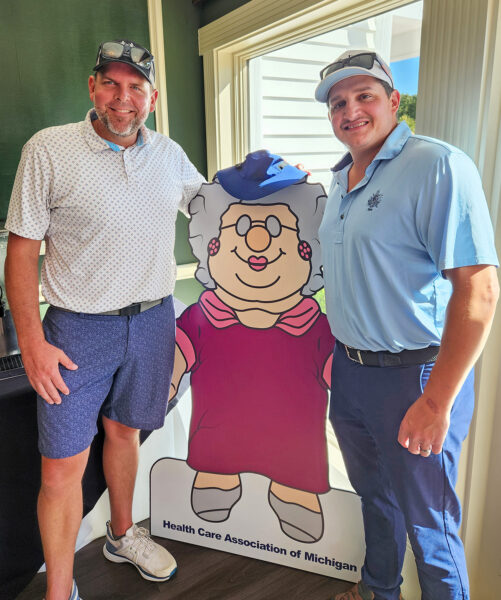
Men’s Closest to the Pin was Derek Damstra with CareLinc and Longest Drive was Brent Hable with Action Medical Equipment.
See more photos from the outing.
Back to Top

MDHHS Issues FY 2027 DCW Reimbursement Guidance
The Michigan Department of Health and Human Services (MDHHS) issued FY 2027 Direct Care Worker (DCW) guidance establishing quarterly interim payments beginning October 15. Payments will be based on each facility’s January-March 2026 DCW reimbursement multiplied by its 2025 Cost Report Medicaid utilization rate, reflecting the end of reimbursement for non-Medicaid hours. Facilities should submit any outstanding January-March requests promptly and contact MDHHS if they cannot do so by tomorrow, September 30.
Facilities must continue reporting all eligible clinical and non-clinical hours. MDHHS will provide facility-specific payment information through MIFTS1 and reconcile payments against reported hours after FY 2027. Updated reporting forms and FAQs are expected in October.
Facilities must distribute the wage funding to eligible employees using a consistent, equitable and documented method. MDHHS does not require a specific per-employee increase, but clinical and non-clinical funding must remain separate. Questions? Email Michael Batts.
FY 2027 QAS Payment Notices Available in CHAMPS
Individual Quality Assurance Supplement (QAS) payment notices are now available to long-term care providers in CHAMPS under “Archived Documents.” The notices apply to payments beginning October 29, 2026. Facilities should review their individual notice to confirm their payment information. You may email questions about QAS calculations to [email protected] or call (517) 335-5356. For help accessing the notice in CHAMPS, email Medicaid Provider Support or call (800) 292-2550.
CMS Releases PEPPER Reports for SNF Providers
The Centers for Medicare and Medicaid Services (CMS) released the FY 2025 Program for Evaluating Payment Patterns Electronic Report (PEPPER) for skilled nursing facilities. These reports offer providers the opportunity to review their payment data, identify trends and billing patterns within that data, and highlight potential areas for internal audit or that may need closer monitoring. Authorized officials, access managers and staff end users can download their organization’s report from the PEPPER Portal. CMS also provides information on how to become a staff end user.
Federal Medicaid Eligibility Change May Affect Long-Stay Residents
Beginning October 1, 2026, a federal law will limit full Medicaid coverage for many lawfully present noncitizens. Refugees, asylees, humanitarian parolees and others may lose coverage unless they also have an eligible status, such as lawful permanent resident status. U.S. citizens and nationals, eligible lawful permanent residents, Cuban and Haitian entrants, and COFA migrants remain eligible under the new immigration rules, subject to other Medicaid requirements.
Nursing facilities may begin to see termination notices for affected long-stay residents. Before assuming coverage has ended, carefully review each notice and confirm the immigration status used in the determination. A resident’s status may have changed since it was last verified. If a resident reports an eligible status that the state cannot immediately verify, federal rules require a 90-day reasonable opportunity period to provide documentation.
Facilities should work with residents or their authorized representatives to review notices promptly and contact the assigned eligibility worker with questions about the determination. An appeal may be appropriate in some cases. Because only residents or their authorized representatives will receive these notices, facilities should also monitor eligibility and claims for residents who may be affected.

CDC Consolidates COVID-19 Infection Control Guidance (SNF/AL)
With the archiving of certain COVID-19 infection control guidelines, the Centers for Disease Control and Prevention (CDC) is conducting a systematic review of how health care providers access COVID-19 infection control guidance.
As we reported earlier this month, the CDC updated its recommendations for managing health care personnel who are exposed to or infected with common respiratory viruses, including COVID-19, influenza and RSV. Stemming from that, the CDC is now archiving the following guidance documents:
• Interim Guidance for Managing Healthcare Personnel with SARS-CoV-2 Infection or Exposure to SARS-CoV-2
• Strategies to Mitigate Healthcare Personnel Staffing Shortages
• Infection Control Guidance: SARS-CoV-2
Specific to COVID-19, the CDC is updating the location where health care providers access recommendations for infection prevention and control for COVID-19. Interim recommendations addressing the type and duration of Transmission-Based Precautions for SARS-CoV-2 infection — including recommended personal protective equipment — are now included in Appendix A of CDC’s 2007 Isolation Guideline, under “Respiratory infectious disease, acute (if not covered elsewhere).”
The CDC is conducting a systematic literature review to reevaluate these interim recommendations and will share its findings when the review is complete.
Current recommended action steps include the following:
(1) Review the current set of CDC guidance on COVID-19 to ensure up-to-date understanding by staff and identify needed education and process modifications.
(2) Update facility policies, protocols and links (if used) to reference the current COVID-19 recommendations. Verify any applicable state and local requirements that should be incorporated into facility policies and/or practices and monitor for additional CDC updates.
Members are encouraged to bookmark CDC’s Guideline for Infection Control in Healthcare Personnel and share the updated resources with their infection prevention and clinical teams ahead of respiratory virus season.
CDC Guidance Update Affects OSHA Compliance (SNF/AL)
The Occupational Safety and Health Administration (OSHA) and the Centers for Disease Control (CDC) have updated their guidance on COVID-19, allowing long-term care facilities to simplify some of their processes.
Recall that in February 2025, OSHA stopped enforcing the special COVID-19 log required under the Healthcare Emergency Temporary Standard. At that time, employers still had to follow the usual OSHA recordkeeping rules for work-related COVID-19 cases. Then OSHA went further in March 2026. Under its current enforcement policy, OSHA will not cite covered employers for failing to record COVID-19 cases on the OSHA 300 Log or report COVID-related hospitalizations or fatalities to OSHA.
As HCAM recently shared, the CDC issued new guidance for viral respiratory infections. It now addresses COVID-19 alongside influenza, RSV and other viral respiratory infections.
After reviewing the changes to both OSHA and CDC guidance, facilities may consider making the following changes:
♦ No longer routinely investigating every employee COVID-19 case for OSHA recordkeeping purposes.
♦ No longer routinely adding COVID-19 cases to the OSHA 300 Log.
However, facilities must continue to follow all infection-control, CMS, public health, workers’ compensation and internal procedures. Serious, unusual, or clearly work-related cases may still be reviewed individually.
This is a positive change for long-term care facilities, reducing unnecessary investigations, duplicate paperwork, and confusion about OSHA recordkeeping, while maintaining appropriate protections for employees and residents.
CDC Updates Guidance for Infectious Conjunctivitis (SNF/AL)
The Centers for Disease Control and Prevention (CDC) updated its guidance for health care workers with infectious conjunctivitis, which is commonly referred to as pink eye. Health care workers with suspected or confirmed infectious conjunctivitis should stay out of work until their symptoms are gone. This simplified guidance includes all infectious conjunctivitis, including epidemic keratoconjunctivitis. This guidance applies to infectious conjunctivitis, not eye irritation caused by allergies or other noninfectious conditions. Clinical leaders should review the updated CDC guidance and update policies as appropriate.
CMS Releases Updated MDS 3.0 RAI User’s Manual Effective October 1 (SNF)
The Centers for Medicare & Medicaid Services (CMS) released version 1.20.11 of the Minimum Data Set (MDS) 3.0 Resident Assessment Instrument (RAI) User’s Manual, effective October 1, 2026.
At a high level, key updates include:
♦ Clarification that MDS items (non-Section S) must be coded according to the CMS item definitions, coding instructions, coding tips and response options in the manual. State or other payer requirements do not replace, modify or add to the item definitions, coding instructions, coding tips or response options specified in the manual.
♦ Revised assessment and coding guidance, including instructions for emergency transfers and resident interviews.
♦ Clarifications related to coding shortness of breath.
♦ Expanded guidance for coding pressure ulcers and injuries, surgical wounds, other skin conditions, and whether an ulcer or injury was present on admission.
♦ Refined instructions for coding isolation and skilled respiratory therapy services.
♦ Clarifying language was added to the depression end split for the Patient-Driven Payment Model in Chapter 6.
Deadline: Members should review the updated MDS 3.0 RAI User’s Manual, share applicable changes with MDS coordinators and interdisciplinary team members, and update internal training and procedures before October 1, 2026. You may also keep an eye out for an update to the American Health Care Association’s comprehensive MDS education – Learning the Minimum Data Set: Basic Training for the Interdisciplinary Team, which is expected soon.

House Committee Holds Hearing on Bills to Change AFC Licensing Act
On September 22, the House Families and Veterans Committee heard testimony on the three-bill package, HB 6320, 6321, 6322 that would change the Adult Foster Care (AFC) Licensing Act. HCAM’s Rich Farran testified in opposition to the bills, on behalf of HCAM’s assisted living members. Recall that in 2025, a similar bill known as “Theresa’s Law” was introduced. While this year’s version is slightly less concerning, it could still have negative impacts on Adult Foster Care providers if signed into law. Please review the bills and email Jenny Post with any feedback that would help in our advocacy efforts as we engage with the bill sponsor, legislative leaders and the Department of Licensing and Regulatory Affairs.
Back to Top
New Law Impacts Landlord/Tenant Relationships
Senate Bill 373 was signed into law on September 22 and is now Public Act 103 of 2026. The new law amends the Truth in Renting Act to prohibit rental agreements from including a provision that imposes an additional charge or fee on every allowable method of rent payment. It specifies that at least one fee-free payment method must be to be available. Violating the law will void the provision of the lease agreement pertaining to payment, with further court action available to the tenant. Many assisted living settings have a landlord/tenant relationship and will be impacted by this new law. If you have questions, please reach out to Jenny Post.
Back to Top

We are pleased to welcome a new assisted living community member — Ellis & Wright Assisted Living Center in Ann Arbor. We look forward to partnering with this adult foster care facility to continue to promote excellence in senior care.
Back to Top